By Justin Lafleur, HSF founder
Most stick advice is either too generic (“get what the pros use”), too technical without explaining why it works for a specific player, or it doesn’t translate to what models you can actually consider to buy in stock.
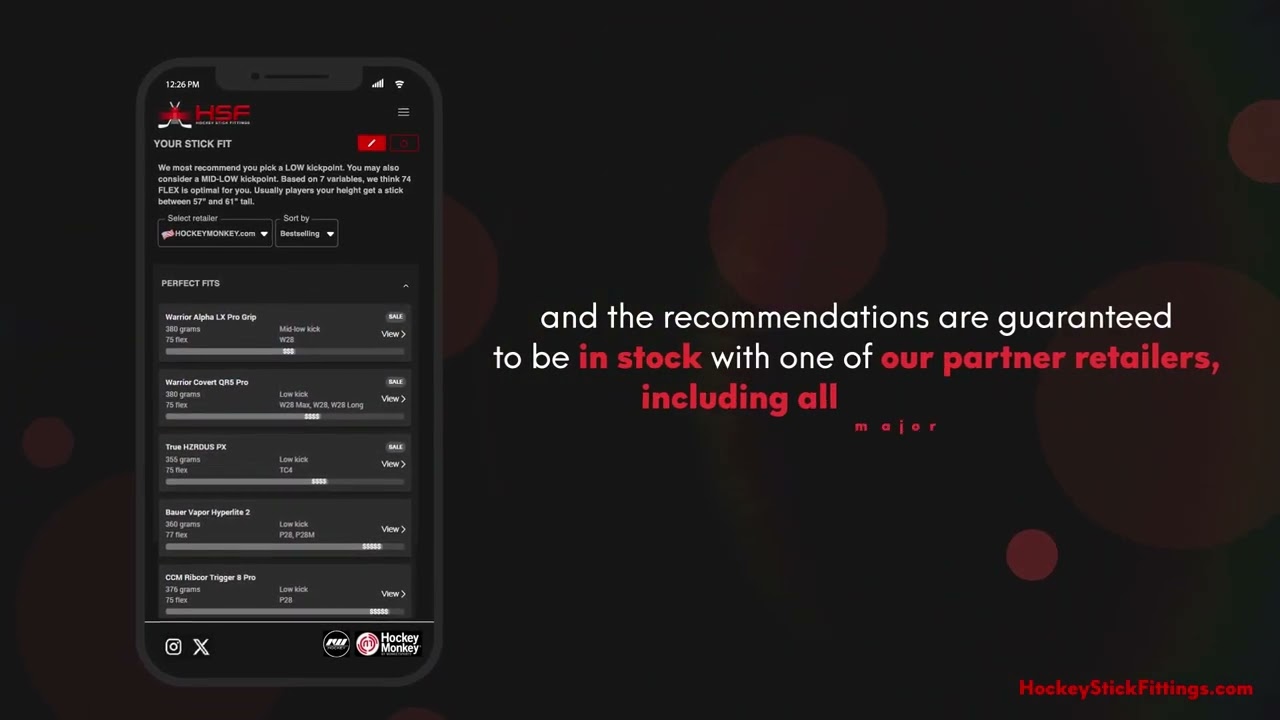
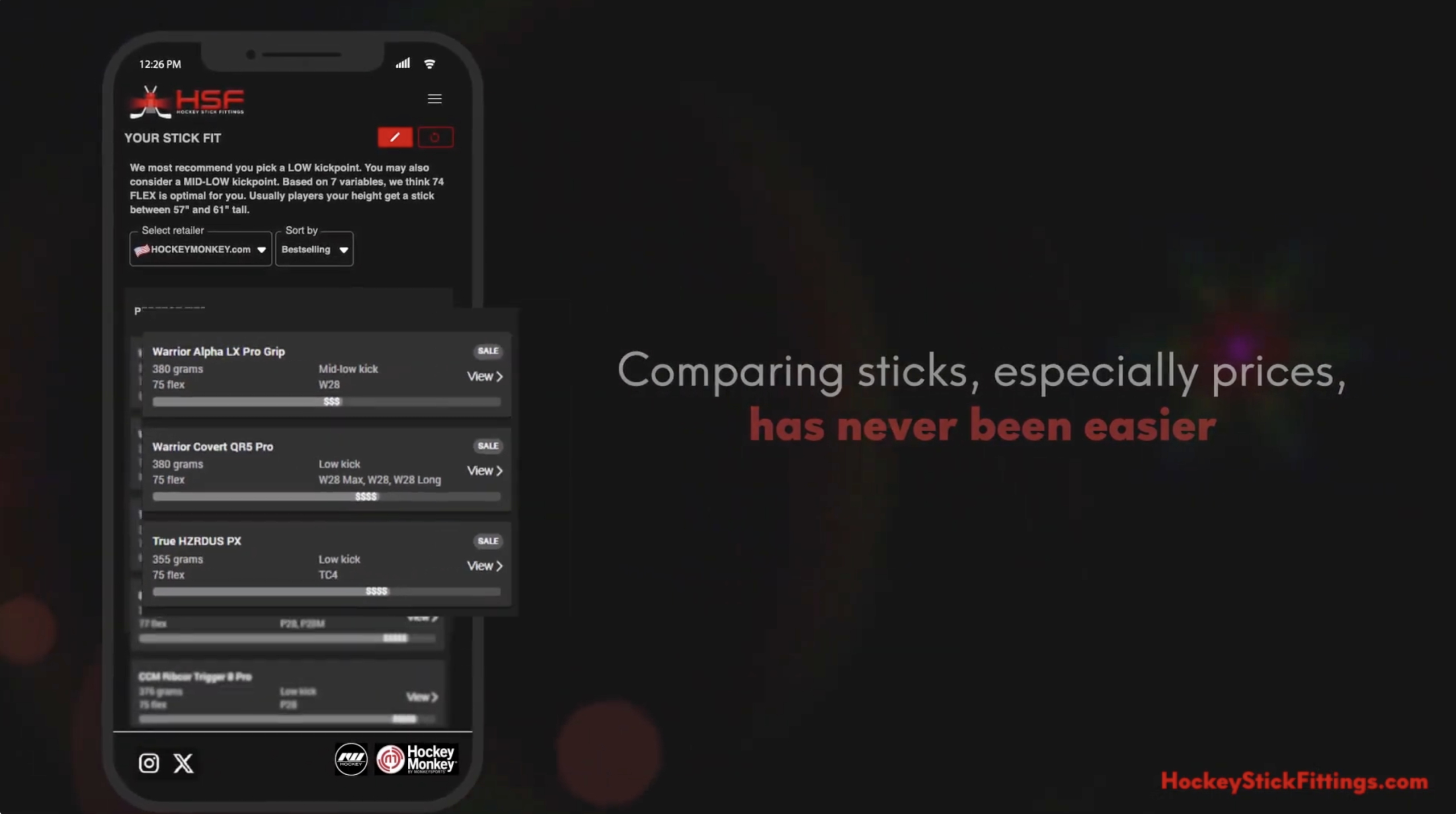
This is the alternative: a simple audit you can run on yourself that turns your next stick purchase into a repeatable decision, not a guess. If you want to run the interactive version, I built a free fitter at HockeyStickFittings.com (no phone, no email, no credit card).
The Stick Fit Audit (in 5 steps)
1) Define your shot profile (your ‘why’)
Before you touch flex or curves, answer these:
– Your two most-used shots: snap shot, wrist shot, one-timer, slap shot, backhand, tips
– Your two most-used locations: off the rush, low slot, high slot, point, in-tight
– Your #1 priority: quickest release, hardest shot, accuracy, puck feel, passing
This matters because kick point and curve selection are basically ‘release’ and ‘puck-behavior’ systems.
2) Get a baseline flex and adjust based on your “why”
| Group | Age | Height | Weight | Flex starting range |
| Youth | 3-7 | Up to 4’4″ | 45-65 lb | 20-30 |
| Junior | 7-12 | 4’4″ to 5’1″ | 70-110 lb | 40-50 |
| Intermediate | 10-15 | 4’11” to 5’6″ | 110-160 lb | 50-70 |
| Senior | 14+ | 5’5″+ | 160+ | 70-102+ |
Above is a practical starting grid, but flex isn’t just a “correct number”, it’s a tuning knob. Your ideal flex depends on how you shoot, because changing flex changes both how fast you can load the stick and how much energy you can store for the shot.
Lower flex (softer): Bends with less effort, so it loads faster and helps you get a quick release. Great for wrist/snap shots, shooting in stride, and tight-space, high-tempo play.
Higher flex (stiffer): Can deliver more power and a more stable feel if you’re strong enough to consistently load it, especially on slap shots and bigger lean-in shots. The trade-off is it takes longer (and more force) to bend, so it can be less effective for quick-release situations if you’re not getting it to flex.
Two rules that save money:
– If you cannot comfortably load the stick in a normal shot motion, it is too stiff for you right now. – If you can load it, then we let the kick point and curve do the specialization.
3) Choose your kick point
Kick point is where the stick wants to flex most.
- Low kick (quick-load / quick-release): The lower shaft is tuned to bend with less “lean,” so you can load the stick when the puck is closer to your body and your hands don’t have time to drop. Best for catch-and-shoots, shooting in stride, tight-space snapshots, and players who create offense off small separation.
- What you’ll feel: the stick “gives” early and the puck jumps off fast.
- Common trade-off: can feel less stable for big leaners/point bombs; if you’re late on release, it can sail high (especially paired with an open toe curve).
- Mid kick (load-then-drive / stability): The bend profile is built to reward weight transfer and a longer load path, so the stick stores energy when you’re leaning through the shot (often with more separation between puck and feet). Best for heavy wristers, slap shots, one-timers, point shots, and players who like to “push through” the puck.
- What you’ll feel: more solid/stable, but it asks for a deliberate load.
- Common trade-off: slower release for quick catch-and-shoots unless your mechanics are strong and consistent.
- Hybrid kick (adaptive / all-around): A blended profile that aims to give you some of the quick-loading feel of low kick while keeping some of the stability/power feel of mid kick. In practice it often “loads where you apply pressure” depending on hand position and how much you lean. Best for players who take a mix of quick-release shots and leaned-in shots and don’t want an extreme, e.g. centerman, offensive defenseman.
- What you’ll feel: easier to live with across situations; fewer “wrong tool for the job” moments.
- Common trade-off: it won’t feel as specialized as a true low-kick snap cannon or a true mid-kick power stick.
NHL reality check
– Mid: 35%
– Ultra-low: 4%
– Low: 31%
– Hybrid: 29%
By position:
– Defense: Mid 38%, Low 30%, Hybrid 27%, Ultra-low 5%
– Centers: Mid 34%, Low 31%, Hybrid 29%, Ultra-low 6%
– Wingers: Mid 33%, Low 31%, Hybrid 31%, Ultra-low 4%
Dive deeper: HSF NHL Insights page
4) Choose your curve family
Curves are where most ‘this stick feels wrong’ problems come from, because they change:
– shot launch angle, accuracy, consistency, stability, feel and deception
– ease of cupping/cradling the puck, toe drag, stickhandling feel
– how forgiving your passes feel, how easy to it is to sauce it
A simple, player-first way to pick:
– Mid curve (ex: P88 / P92): the ‘do everything’ family; easier to keep pucks flat; great if you want balance.
– Toe curve (ex: P28 / P90TM): built for pulling the puck in and snapping it; great for quick-release shooters; can make it easier to miss high if you do not adjust. Great for quickly, aggressively and deceptively raising the puck in-tight. Trades off on stability as it can be erratic depending where it is released from on the blade especially when new to it (not forgiving).
– Heel curve (ex: P91A / PM9): strong for leverage, passing, and a traditional feel; can be great if you shoot more ‘through’ the puck.
If you are not sure: start mid curve, then move toe/heel based on your experience.
5) Buy in the right tier (performance vs durability vs cost)
If your specs are right, tier becomes a performance/budget/durability choice. You unfortunately can’t maximize all 3.
– Elite: under ~405g, typically $240+ (lightest, best feel/performance, often compromises durability)
– Competitive: ~405g-460g, $140-$240 (durable with strong, but not top-tier, performance)
– Recreational: under ~$140 (heavier, but totally fine for casual use, you may never break it)
————————————–
With this knowledge, you’re equipped to shop by specs, not hype, across retailers, brands, and models. Compare the sticks that match your fit by weight and your price-to-performance tradeoff. If you’re still torn between kick points, flexes, or curves, try them briefly, either by demoing options at a local store (if offered) or borrowing a teammate’s stick for a few minutes during warmups or practice.