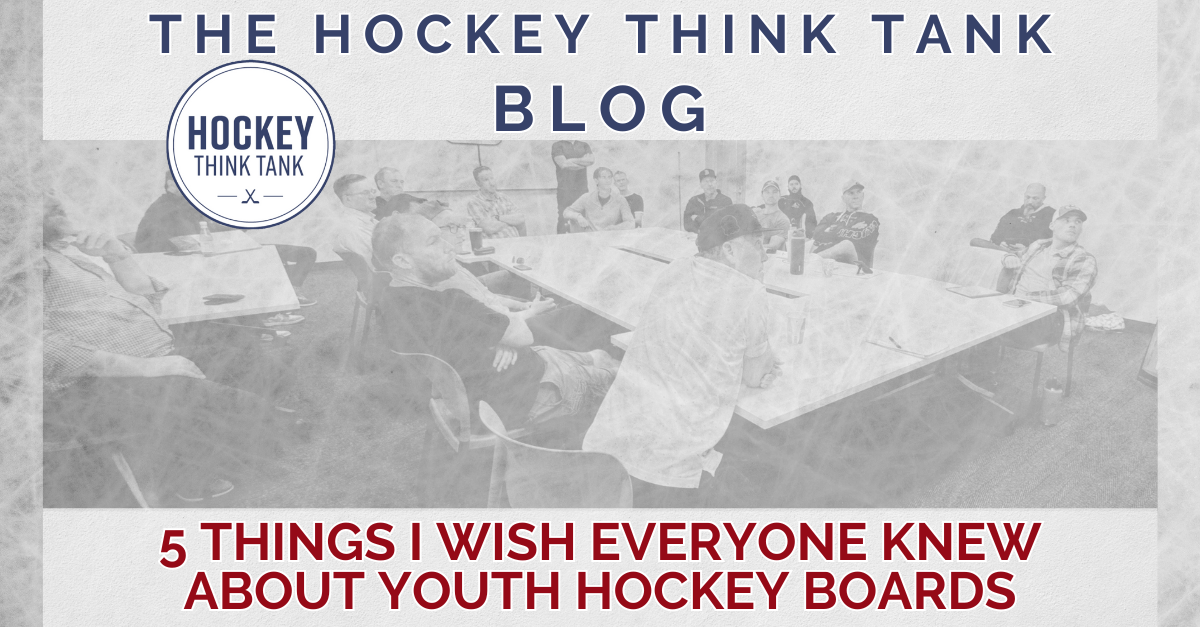
I’ve learned so much about the youth hockey ecosystem over the past few years since going all-in with the Hockey Think Tank. A lot of our focus has been on coach and parent education along with building player life skills, but one thing I’m realizing as I dive deeper into what makes youth hockey go round is the role of what could be the most important entity in hockey:
The Youth Hockey Association Board.
Not knowing much about the role a board plays previously, the conversations I’ve had over the past 3+ years have been extremely eye-opening. I’ve learned that the functionality, makeup, and operational efficiency of the board plays such an important role in the success of any youth hockey association.
The tough part though:
I speak with a lot of board members that are burnt out. Volunteers that raise their hand with the best intentions realize that getting involved just made their life 10x more stressful.
The seemingly never-ending strain of dealing with parents with rose-colored glasses. Other board members with self-serving agendas. Aloof or non-existent people in leadership positions. The political nature or lack of support from governing affiliates. Parents and coaches that refuse to buy in.
It takes a toll on the incredible volunteers that we wouldn’t have a sport without.
Many of the associations we talk to are having a hard time getting people to be a part of the leadership of their association. Parents don’t want to join the board due to horror stories they hear from people currently in those positions.
That’s not to say that all boards and experiences are like that – they aren’t. But if you talk to volunteers or others in leadership positions in youth hockey, one of the biggest issues we see is a lack of people that want to get involved at the board level.
I really wish that more people understood the role a board plays and show some empathy for the decision making that happens at that level. As I said before, most people who raise their hand to be in a leadership position do it for the kids and the betterment of the entire club. They want to make a real impact and sacrifice a lot of their time (and sanity) to create a positive environment for the kids and families in their association.
So with that, my HTT here team put our heads together and we want to share the 5 biggest things we want the youth hockey world to know about youth hockey boards.
1. Youth hockey boards don’t exist to make everyone happy. They exist to make the organization healthy.
That sounds obvious…until you’ve sat through a board meeting where 80% of the energy goes to senseless drama that doesn’t move the needle forward. And to be blunt, it’s impossible to make everyone happy.
Here’s what board members have to consistently deal with relating to parents within an association:
-You are going to have 10-20% of parents that want to always PUSH – more games, more ice, more trophies, more focus on the elite.
-You are going to have 10-20% of parents on the complete opposite end of the spectrum that think youth hockey is nuts, it’s way too much, and they can’t believe their kid actually likes it.
-And then you are going to have the rest that are somewhere in between and can be swayed one way or another based on the culture of their specific team.
Also…
-You are going to have 10-20% of parents that want to shorten the bench, play to win, and cater to the top players.
-You are going to have 10-20% of parents that want equal ice time, they could care less about winning, and think every kid should get equal opportunity.
-And then you are going to have the rest that are somewhere in between and think there’s a middle ground there depending on a lot of different factors.
Case in point: Board leadership is going to field feedback from all ends of the spectrum and depending on the parent group, they may get complaints that completely contradict each other. I’ve seen one parent argue that the coach isn’t shortening the bench enough…and another parent argue that the coach is shortening the bench too much…on the same team!!
The best boards do not placate. They have a defined mission, vision, and processes and they have a commitment to accountability for everyone in the association to live up to those standards. The ones that make decisions to appease overbearing parents, in an effort to reduce conflict, only end up creating more conflict in the end.
Sometimes hard decisions have to be made. And sometimes those decisions are going to make people upset. That’s ok. Just have some grace for your leadership group as many times decisions are will go well with some people and not so well with others. Their job is to do what’s best for the entirety of the association.
2. On many boards, 90% of the work is done by 10% of the people
Most people on volunteer boards are parents that have multiple kids, jobs, and a million other responsibilities in their lives. And with that, you are going to have a varying degree of effort that people are either willing or able to put into being on the board.
Based on the composition of the board, there will also be varying degrees of tasks that need to be done. For example, if you have a paid hockey director and admin – there will be much less for board members to do and their roles may be more advisory than action oriented. But if you have a pure volunteer board, the members will need to execute on A LOT of things to make sure the association functions, let alone thrive.
One of the things we hear a lot about is the burnout from the volunteers that seem to take on that 90% of the load while others fail to make an effort to execute on the tasks they’ve been assigned. It’s for various reasons why some board members don’t meet the expectation, with some excuses having more merit than others, but if you treat a board member that is clearly putting in time with disrespect – take a minute to take a step back and think about all the time they are donating to help you and how much crap many have to put up with on a consistent basis.
I have come to have SO MUCH RESPECT for people that volunteer their time. SO MUCH RESPECT. I hope that everyone reading this can take that perspective and practice some empathy for those that raise their hand. They are doing SO MUCH behind the scenes that will never be seen or acknowledged. But know, those people raising their hand are some of the most important people in your son or daughters growth and development as players and people.
3. Youth Hockey Boards should have a clear separation of hockey and admin roles
We all know or have heard of over-zealous parents that join boards so they can manipulate things to benefit their own kid. It’s a tale as old as time.
That’s why it’s so important to have a separation of “church and state” when it relates to the hockey decisions that need to be made and the administrative decisions that need to be made within an association.
This is easier when you have a paid hockey director and staff. But even for a complete volunteer board, there needs to be boundaries between the two.
Many volunteer associations, particularly in Minnesota, have a “Hockey Committee” that is tasked with the hockey specific programming and responsibilities. They also have a group committed to the administrative tasks like the finances, fundraising, rules and ethics, etc…
By having separate groups with clearly defined responsibilities, it can help ease the political tension and pressure that comes with running the operations of an association.
There’s a lot that needs to get done on both sides. And when you have that clear allocation of responsibilities filling those roles with members that have a knowledge or passion for those specific responsibilities, it goes a long way for building a healthy, effective, and efficient association.
4. Transparency is the everything
Boards need to be transparent.
BUTTTTTTTTTTT…
Parents need to be transparent too.
It’s a two-way street of effective communication that means everything to the health and culture of a youth association.
When the leadership is transparent in communicating the standards, priorities, values, and accountabilities of the association, they’ll field a lot less questions from confused, upset , resentful parents. By being proactive in communicating how things operate and why decisions are made, boards will put out many fires before they even start.
And then, it’s important to LISTEN. By being open to feedback and welcoming criticism and questions, they live the growth mindset they’re more than likely preaching to their coaches and players about always developing and getting better.
When clubs aren’t transparent or open to feedback, it creates an ivory tower and lack of trust from the group of parents that leads to a dysfunction and a culture of mistrust.
On the other side, transparency and upfront communication is important by the parent group of an association as well. The biggest thing that sinks a club is cliques and backdoor gossip. In these cases, when issues arise, everyone huddles in their little groups and speaks negatively about other groups about what is going on.
I’m a big believer that energy is contagious, and when that negative energy starts to spread through hush-hush interactions – it’s hard to stop that destructive momentum and faith in the organization cracks.
The two-way street of parents bringing issues to the board – and the board being receptive to change and following through with change – it’s EVERYTHING to the health of the association. If either side splinters, it can spell trouble for the culture at large.
Healthy, transparent communication is the oxygen an association needs to breathe.
5. Mission Statements and Bylaws Still Matter
Are they exciting? No.
Are they the backbone of a functional organization? Absolutely.
A clear mission statement and up-to-date bylaws:
- Anchor decision-making
- Reduce emotional reactions
- Provide consistency when leadership changes
- Protect the organization during conflict
They aren’t there to collect dust. They exist to answer hard questions like:
- Why do we do things this way?
- What matters most when things get messy?
- What experience are we trying to deliver to families?
When boards operate like it’s the Wild-West, it creates a culture of favoritism and preferential treatment. By-laws are there as the North Star when there is conflict or dispute and, in some cases, can be the anchor to keep associations out of legal trouble.
And parents – by-laws are there for a reason. They exist to make sure that there are processes and procedures in place which minimizes the chaos and uncertainty in decision making. Again, boards exist to keep an association healthy – not to make everyone happy. Every decision made by the board will be scrutinized. But by having detailed and concrete by-laws, it provides consistency and impartiality that has the health of the WHOLE association at the forefront.
Have some grace.
As I said earlier, the majority of people that raise their hand to be on a board are over-worked and under-appreciated. The work they do goes unseen but associations don’t just operate out of thin air. There’s so much time and effort that goes into operating a successful youth hockey association.
Do the people on the board always get it right? No.
Are there people on the board that might join for less-than-ideal reasons? Probably.
But the next time you feel emotional about the things that are going on within the association, remember that those people are dedicating their time and effort, sacrificing time with their families, to help your kid. I have two challenges for you:
1. Say thank you to a board member you feel deserves it. I guarantee that gesture will mean more than you think.
2. Get involved. Our game thrives when great people raise their hand and offer their knowledge and time. Making an impact on the youth of our game is one of the most gratifying feelings in the world. And if you feel like you’d like to make that difference, I’m sure the association would love to have you on board.
If you would like to talk to us about working with your organization for the upcoming season – check out our Youth Organizational Blueprint here!
With a broad mix of services, resources, and deliverable tools, The Hockey Think Tank’s Organizational Blueprint is designed to give clubs clear direction, purpose, and organization. No matter how you measure success — on-ice performance, player development, enthusiastic retention, or satisfied families and coaches — the Organizational Blueprint provides the map to spark positive changes, today.