It’s that most exciting time of year– college hockey is back!
Last fall, I typed that same sentence. And then spent almost 3000 words unpacking all the reasons we were in a brand-new world.
CHL players were suddenly eligible. Revenue sharing had arrived. Programs were working around a new 26-player roster limit. The transfer portal was still churning. Former professional players were entering NCAA hockey through doors that had never previously existed.
College hockey had changed so quickly that nobody really knew which developments were permanent, which were a market correction, and which were simply the product of one chaotic offseason.
Now we have another year of evidence.
And the clearest conclusion is this: the college hockey evolution continues.
CHL Continues to Rise
In 2025–26, 174 of the 516 incoming freshmen tracked by College Hockey Inc. came directly from the Canadian Hockey League. That was nearly 34% of the entire class.
That first-year surge was enormous, but it was also a one-time market correction: an entire player pool became eligible at once.
Year 2 did not produce another comparable spike. Instead, CHL representation continued to grow at a slower rate—evidence that the pathway is becoming embedded.
The 2026–27 roster data again compiled by College Hockey Inc. identifies 233 freshmen coming directly from the WHL, OHL or QMJHL. That represents 46.5% of the 501 freshman players.
| Previous league | 2024–25 | 2025–26 Year 1 | 2026–27 Year 2 | Δ Year 1 to Year 2 |
| WHL | 0 | 77 | 91 | +14 (+18.2%) |
| OHL | 0 | 59 | 83 | +24 (+40.7%) |
| QMJHL | 0 | 38 | 59 | +21 (+55.3%) |
| Total CHL | 0 | 174 | 233 | +59 (+33.9%) |
Note: Four additional players entering Division I directly from CHL teams are listed as upperclassmen because of their individual eligibility classifications. The freshman analysis throughout this article follows the class designation in the roster data, but either measurement points in the same direction.
Last season, 50 NCAA programs had at least one CHL freshman and 32 had three or more. This season, 60 of 63 programs have at least one, while 42 have three or more.
RPI leads the country with eight CHL freshmen. Denver, Michigan, Omaha, Penn State and UConn each have seven. Ferris State, Massachusetts, Merrimack, Michigan State, Northeastern, Quinnipiac, Sacred Heart and St. Cloud State each have six.
Only Air Force, Army, and Wisconsin do not have a freshman arriving directly from the CHL. The service academies are a special case: their standard admissions path requires U.S. citizenship, making the USHL and NAHL denser recruiting pools of eligible players than the largely Canadian CHL. U.S. citizens who play in the CHL remain eligible for the academies, and we may well see them on those rosters in future years. Set the two academies aside, and only 1 of the other 61 Division I programs is without an incoming freshman directly from the CHL. And even that program, Wisconsin, had two CHL recruits in 2025-26 and this past summer received a portal transfer only a year removed from the CHL.
This is no longer a handful of programs exploiting a newly available market. CHL recruiting has become standard operating procedure across the landscape.
That broad adoption reflects what programs learned in Year 1. Coaches entered the first CHL recruiting cycle with reasonable questions about academics, schedule adjustment, roster culture and whether major-junior production would translate. One season provided enough reassurance to keep recruiting aggressively.
The first class produced immediate stars and useful players throughout the lineup. Gavin McKenna went from Medicine Hat to Penn State, scored 51 points in 35 games and became the first selection in the 2026 NHL Draft. Porter Martone followed a 98-point OHL season with 25 goals and 50 points in 35 games at Michigan State, then recorded 10 points in his first nine NHL games to help Philadelphia reach the playoffs. He became the first teenager in NHL history to score the game-winning goal in each of his first two career playoff games. Those were exceptional outcomes, but the larger class collectively cleared the threshold that mattered: proof of concept.
The NCAA added one Division I program for 2026–27, but Maryville’s arrival did little to change the larger capacity problem.
And so every additional player entering from the CHL still occupies a place that might once have gone to a player from the USHL, BCHL, NAHL, a Canadian Junior A league, Europe, prep school or high school hockey.
The trends in freshman sourcing illustrate the squeeze:
| Previous league | 2024–25 | 2025–26 | Δ Year 1 | 2026–27 | Δ Year 2 | Δ two years |
| USHL* | 179 | 150 | -29 (-16.2%) | 134 | -16 (-10.7%) | -45 (-25.1%) |
| BCHL | 126 | 89 | -37 (-29.4%) | 59 | -30 (-33.7%) | -67 (-53.2%) |
| NAHL | 105 | 60 | -45 (-42.9%) | 47 | -13 (-21.7%) | -58 (-55.2%) |
| NTDP | 16 | 13 | -3 (-18.8%) | 6 | -7 (-53.8%) | -10 (-62.5%) |
| AJHL | 15 | 2 | -13 (-86.7%) | 1 | -1 (-50.0%) | -14 (-93.3%) |
| OJHL | 8 | 6 | -2 (-25.0%) | 0 | -6 (-100.0%) | -8 (-100.0%) |
| SJHL | 6 | 2 | -4 (-66.7%) | 1 | -1 (-50.0%) | -5 (-83.3%) |
| NCDC | 6 | 3 | -3 (-50.0%) | 3 | 0 (+0.0%) | -3 (-50.0%) |
| MJHL | 7 | 1 | -6 (-85.7%) | 2 | +1 (+100.0%) | -5 (-71.4%) |
*NTDP players are separated from the USHL total. The 2025–26 figures reproduce the baseline used in last year’s article. The 2026–27 figures come from College Hockey Inc.’s roster data and use each player’s listed class and last league.
The USHL remains the strongest producer on a per-team basis. Its 16 clubs supplied 134 Division I freshmen this season—approximately 8.4 per team, compared with about 3.8 per CHL team. No league produces NCAA players more efficiently. The best American players also continue to thrive there. Ethan Wyttenbach went directly from Sioux Falls to Quinnipiac and led the country in scoring as a freshman.
So the USHL is not disappearing, and on a percentage basis it’s market share decreased the least of any source listed in that table. But it no longer possesses an eligibility-protected place atop the American developmental pyramid. It now competes with 61 CHL teams for many of the same elite American and Canadian players—and those players know they can choose either route without closing the college door.
The BCHL’s decline may be even more consequential. The league’s decision to leave Hockey Canada gave it an independent identity, but CHL eligibility removed the advantage that had once made Canadian Junior A the preferred domestic route for players determined to preserve NCAA options. A decline from 126 freshmen in 2024–25 to 89 in 2025–26 and now 59 in the current roster data is not a small fluctuation. It is a structural warning.
The NAHL has now declined from 105 freshmen two years ago to 60 last year and 47 this season. It still has an important role, particularly for late developers and players needing more time, but it is operating farther from the Division I doorway.
For the smaller Canadian Junior A leagues, the NCAA pipeline has narrowed from a lane to a crack. Their future value may increasingly come from developing players for movement into the CHL rather than functioning as a parallel route around it.
The CHL’s share of NCAA freshmen may continue to grow, but the first two years should not be treated as a straight-line forecast.
The jump from zero CHL freshmen in 2024–25 to 174 one year later was a unique event. An entire player pool became eligible overnight, releasing years of accumulated talent into the NCAA market at once. Year 2 brought further growth to 233 freshmen, but it wasn’t the same Black Friday shopping spree. It was the first full recruiting cycle conducted with a widespread understanding of the landscape.
The CHL’s freshman share will eventually find its level. But the competition for the players to fill the junior ranks may not: CHL teams are making an unprecedented push into the American talent market.
The raw draft totals can be misleading because the size and structure of the drafts change yearly, but the share of selections used on Americans tells the clearer story.
| League | 2024 | 2025 | 2026 | Δ 2024–26 |
| WHL | 51 of 283 (18.0%) | 66 of 271 (24.4%) | 60 of 206 (29.1%) | +11.1 pts. |
| OHL | 32 of 302 (10.6%) | 80 of 303 (26.4%) | 89 of 301 (29.6%) | +19.0 pts. |
| QMJHL | 12 of 254 (4.7%) | 37 of 219 (16.9%) | 49 of 216 (22.7%) | +18.0 pts. |
Note: Figures show American players selected as a share of all selections. WHL totals combine the regular and U.S. Priority drafts in 2024 and 2025. The separate U.S. draft was eliminated in 2026.
In 2024, Americans accounted for less than 11% of OHL selections and less than 5% of QMJHL selections. Two years later, those shares had climbed to nearly 30% and 23%, respectively. The WHL used fewer total selections in 2026 than in either of the previous two drafts, yet Americans still increased from 18% of its draft pool in 2024 to 29% in 2026.
That is not passive interest. The CHL is adapting its model to compete for American players—drafting more of them, hiring U.S.-based scouts and placing greater emphasis on academics and NCAA eligibility. Its teams are not merely preparing their traditional player base for college hockey. They are making deliberate changes to recruit a newly available player pool and support those players’ desired path to the NCAA.
Current player movement reflects the same strategy. According to eliteprospects.com roster data, 151 players who appeared in the USHL during 2025–26 are now listed with a WHL, OHL or QMJHL team. Of those players, 115 are American and 22 have already been selected in the NHL Draft. Conversely, 27 players moved from the CHL into the USHL or NTDP, none of whom have been drafted by NHL clubs.
That comparison is not a direct measure of league quality. The players are at different ages and stages of development, and many remain years away from college. Some were cut or released and crossed a border to find a new home. Others are representative of the kind of player movement that occurred before the CHL-eligibility era. And the imbalance in movement north may also reflect the same post-eligibility recalibration visible in the NCAA freshman data and could flatten as the market settles. For now, it reinforces what the draft data shows: CHL teams are making a more deliberate effort to recruit prominent American prospects.
The USHL remains exceptionally well positioned in that competition. Its concentrated talent, development record, experience supporting academic commitments, and direct connection to NCAA programs remain powerful advantages. Recent investments in player development, NHL partnerships, and league leadership staff provide reasons for optimism. NCAA eligibility may no longer be exclusive to its recruiting pitch, but the league remains central to the American development system.
At the league level, the competition is intensifying. The USHL, CHL, NTDP, BCHL and other junior leagues retain different identities, but they increasingly pursue the same players and compete to offer the most attractive development experience. Players have more freedom to move, forcing leagues to work harder to attract, retain and support them.
At the system level, however, those competing pathways are becoming more concentric. The leagues are battling for players, influence and position, but they are increasingly organized around the same destination: NCAA hockey. College eligibility is no longer the dividing line between separate development systems. It is the common outcome around which the North American hockey landscape is reorganizing.
Other Sources Increase Scarcity
The easiest way to misunderstand this new landscape is to frame it entirely as one junior league vs another. The larger story is scarcity.
College hockey has added a massive eligible player pool without adding anything close to a corresponding number of roster spots. Maryville’s arrival brings the current Division I field to 63 programs, but the House settlement roster limit remains 26 for participating schools. NCAA rules also contain exceptions for certain designated players affected by the initial implementation, making some roster totals appear larger during the transition.
The pressure from other sources has not disappeared, but it has changed shape. Year-over-year movement shows which channels kept growing and which began to recede:
| Source | 2025–26 | 2026–27 | Δ |
| Confirmed Division I transfers | 194 | 206 | +12 (+6.2%) |
| U Sports arrivals | 40 | 11 | -29 (-72.5%) |
| AHL/ECHL arrivals | 4 | 10 | +6 (+150.0%) |
Note: Confirmed transfers count players who landed at another Division I program, not everyone who entered the portal. The increase in AHL/ECHL arrivals is substantial by percentage but still represents only six additional players.
Confirmed Division I-to-Division I moves rose modestly, from 194 last season to 206 this season. The sharper changes came from the newer channels. U Sports arrivals fell from 40 to 11, suggesting that the first-year surge largely canvassed former CHL and Canadian Junior A players already established at Canadian universities. Like NCAA Division III, U Sports may still produce the occasional late developer who earns another look, but it is not an endlessly renewable pool. Arrivals from the AHL and ECHL increased from four to 10—still a small group, but another sign that coaches are searching more broadly for players ready to contribute immediately.
The result is a deeper player market competing for roughly the same number of opportunities. That scarcity is making Division I harder to reach, but it is also raising the standard of the players who win those spots.
The scarcity story has another side: the players who do reach Division I are creating a concentration of talent that college hockey has never seen.
Take Michigan State. According to College Hockey Inc roster data, the Spartans are slated to carry 10 former first-round NHL picks in 2026-27. Five Michigan State commits were selected in the first round of the 2026 NHL Draft alone, tying the record for one school. In all, their roster will include 17 drafted players.
That roster is anecdotal, but the larger trend is not. A record 19 current or committed college players were selected in the first round in 2026, including 11 incoming freshmen for 2026–27 and three players committed for 2027–28. Across all seven rounds, 110 current or committed college players were chosen—the most since the NHL adopted its seven-round format in 2005.
The rise is visible over a longer horizon, too. College hockey produced 88 first-round picks in the 2017 through 2026 drafts, up from 57 the previous decade, a 54% increase. Division I rosters included 258 NHL draft picks in 2025–26, 18 of them first-rounders—the highest total in at least a decade. The four Frozen Four teams carried 49 drafted players combined; only the 2024 Frozen Four had more during College Hockey Inc.’s tracking period.
And those trends are manifesting at the NHL level too. A record 249 former college players appeared on NHL opening-night rosters earlier this week, one season after NCAA alumni accounted for a record 42% of NHL debuts.
Put together, those numbers describe more than a recruiting boom. College hockey is approaching a quality level without precedent in the sport’s history: deeper rosters, more elite teenagers, more first-round talent and a stronger direct connection to the NHL The same forces making a roster spot harder to earn are also making the product better.
The changing pipeline is also colliding with a political issue that barely registered in the national conversation until recently: American representation in NCAA athletics.
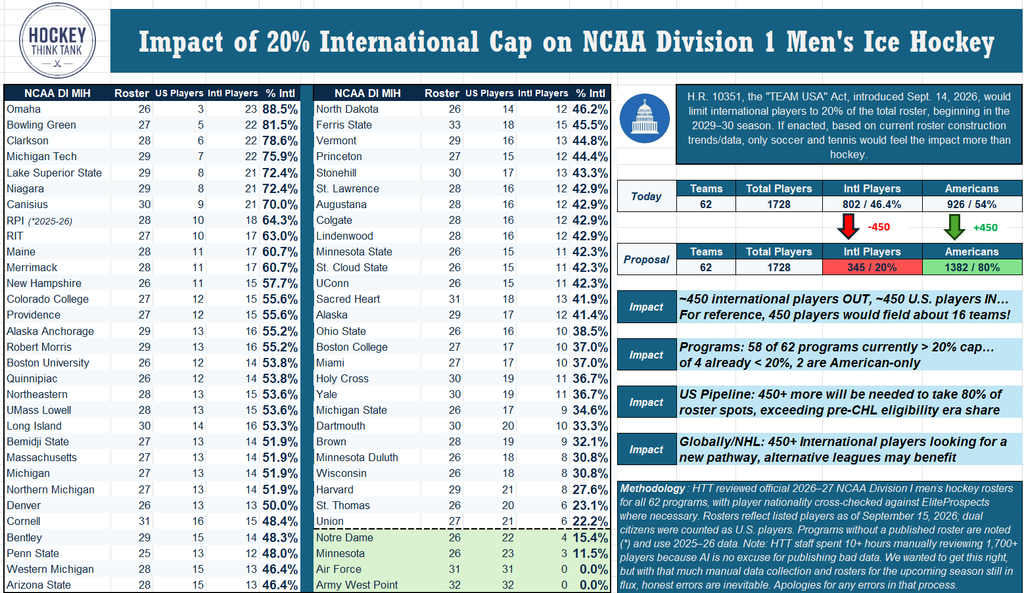
Our separate audit of every published 2026–27 Division I men’s roster found that 53.6% of players were American/U.S.-nationality players and 46.4% were international as of September 15.
That does not mean CHL eligibility alone caused the international share. Canadians and Europeans have been central to college hockey for decades. And many American players now develop in Canadian leagues and vice versa. League of origin and nationality are different measurements.
But the direction of travel is clear: NCAA hockey is becoming more international at the same moment access has become more competitive.
The proposed TEAM USA Act would limit international athletes to 20% of a college roster beginning in 2029–30. It is only proposed legislation, and there is a long distance between introduction and implementation. But if enacted as introduced, hockey (both men’s and women’s) would face one of the most disruptive roster adjustments in NCAA athletics.
Based on current roster composition, around 450 international players would have to be displaced or replaced to comply with the 20% cap—not because of performance, academics or conduct, but because of nationality.
The proposal is unlikely to reshape recruiting decisions while passage remains remote. If it begins to move toward law, however, expect immediate debate about recruiting strategy, implementation timelines, and how current international players would be treated during the transition.
Year 1 showed what was possible. Year 2 began to show what might be permanent.
The CHL is now a major NCAA recruiting source, not a temporary response to a rule change. The USHL remains essential and extraordinarily productive, and is working to build new competitive advantages where eligibility protections once stood. The BCHL, NAHL and Canadian Junior A leagues are being forced to reconsider where they fit. Across the system, the old boundaries are disappearing while the concentration of talent in college hockey continues to rise.
The final balance is still unsettled. The competition among junior leagues for American players will keep evolving, as will the ways leagues recruit, retain and develop them. Revenue sharing, NIL, roster limits, and possible federal legislation could reshape the market again.
But college hockey is not returning to its old structure. Players have more freedom, leagues are competing across a larger map, and NCAA programs have access to a deeper talent pool than ever before.
Last year, the question was whether college hockey had entered a new world.
After Year 2, that question has been answered.
A Final Note: What This Means for Young Players
This can all sound really daunting. In one sense, it is. The recruiting map is wider, the player pool is deeper and the competition for roster spots is more intense.
But something important has also become easier.
A few years ago, players and their families needed a clear roadmap unusually early. They had to decide whether the goal was college hockey or major junior, align every league decision with that outcome and avoid choices that might permanently close one path. Teenagers were being asked to protect a vision of their future before they necessarily knew what that future should look like.
That pressure has largely disappeared. Players can make decisions based on the opportunity in front of them without treating every choice as an irreversible declaration of where they intend to finish. The decision still matters, but it no longer has to determine everything that follows.
The wider recruiting map creates more routes to college hockey, even if it does not create more roster spots. Meaningful minutes, strong coaching, physical development and the right academic runway matter more than the league logo. A player buried in a prominent league—or miscast on an “elite” team—is not automatically closer to college hockey because of the brand on the jersey.
So find the environment that gives you the best chance to improve. Then get really, really good. The pathway can take care of itself.
Now let’s watch some college hockey!
The 2026–27 sourcing analysis uses College Hockey Inc.’s 63-team roster data and includes 1,749 players. Freshmen are defined by the listed class field, producing a class of 501 players. The CHL total includes freshmen whose last league is listed as the WHL, OHL or QMJHL. NTDP players are separated from the USHL. The nationality figures in this article come from HTT’s official-roster audit as of September 15, 2026. U Sports and AHL/ECHL arrivals are counted by Division 1 entry date, not grade classifications. The 2026–27 confirmed-transfer count uses College Hockey Inc.’s roster data; the 2025–26 comparison comes from the contemporaneous College Hockey News transfer tracker cited in last year’s article.