It’s that most exciting time of year– college hockey is back!
Ordinarily I’d just throw myself into the season, but we’re back after maybe the wildest 12 months in the history of college hockey.
Let’s pause for a moment before we kick off the first college hockey season on this brand new planet.
Where to begin?
In a move impacting all of NCAA sports — there was a House Settlement allowing schools that opted “In” to conduct revenue sharing and enabling direct payment to players. It also capped rosters for hockey at 26.
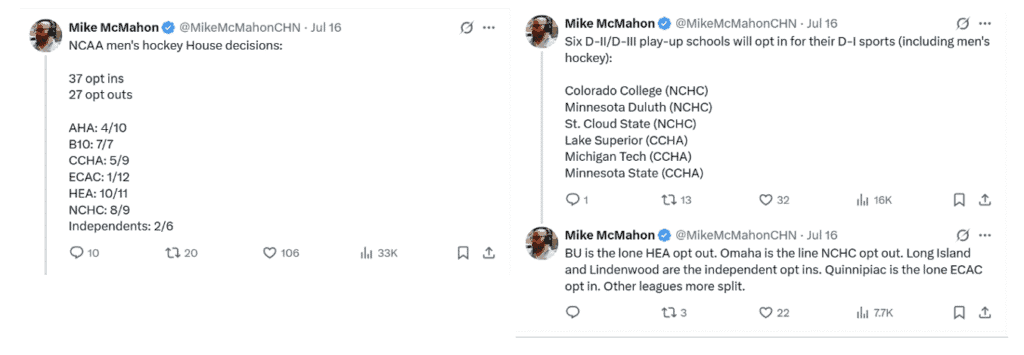
Many historically strong programs elected to opt out and will likely remain strong programs for the foreseeable. Plenty of teams that opted in may find the terms are not an immediate panacea. The most impactful and immediately visible side-effect of the House Settlement is likely to be the 26-man roster; come December and January when injuries, sickness, suspensions, and international team duties converge, we’re likely to see prolonged stretches of teams fielding less-than-full gameday rosters. How that phenomenon taxes and compounds already shorthanded rosters may prove 26 an untenable limit, invented by administrators without the input of coaches.
Elsewhere, there was continued activity in the transfer portal. According to the tracker at collegehockeynews.com, at least 194 NCAA Division 1 players moved to a new program this summer, and another 40 moved down/out of NCAA D1 altogether. On average that’s almost 4 departures and replacements per team, and about 14% of all NCAA D1 players moved in the portal this past offseason.
There recently emerged a new corridor in the maze of amateurism: eligibility of former pro players. There will be four players in NCAA D1 hockey this season who last played for teams in the East Coast Hockey League (ECHL) and American Hockey League (AHL)—two bona fide professional hockey leagues who serve as farm systems to the National Hockey League (NHL). Add another 40 players coming to college hockey from the Canadian USport System (their version of college hockey), some of whom have accrued their own professional league experience, and you have another substantial injection of players from novel sources.
But the biggest story of all—heck, maybe the biggest story EVER in college hockey…
Major Junior players are eligible for NCAA D1 hockey. After generations of exclusion, players from the 61 teams in the Canadian Hockey League (CHL)— an umbrella covering the Western Hockey League (WHL), Ontario Hockey League (OHL), and Quebec Maritimes Junior Hockey League (QMJHL)—were deemed eligible for NCAA Division 1 participation. Overnight, the entire amateur hockey landscape shifted.
And since that news became known, the forecasted impacts have been in overdrive.
A sampling of the predictions…
- NCAA hockey would immediately recruit CHL players on an industrial scale.
- Capitalizing on resources and brand-recognition, the NCAA would target and secure many of the best “underage” CHL players, and in doing so perhaps take a foothold above the CHL in the perceived developmental pathway.
- No longer subject to a siloed CHL vs NCAA “one or the other” roadmap, American and Canadian players would begin acting upon their wider range of options.
- With NCAA options now alive for CHL players, CHL teams would take a more aggressive approach to recruiting American players to their ranks.
- “Human sacrifice, dogs and cats living together… mass hysteria!” – Peter Venkman
But now it’s October. Yesterday’s conjecture is today’s reality.
From the published rosters of 64 NCAA Division 1 squads, we can draw concrete conclusions about exactly what has transpired over the past 12 months. Time will tell whether the class of 2029 was predictive of the world ahead—was it an early over-correction exaggerated by suddenness, or the first indicator of durable trend lines?
But in the short term, we can finally definitively evaluate the impact the CHL-eligibility news will have on the season we’re about to enjoy.
CHL Freshman
Around the country, it would seem most NCAA programs have jumped into the CHL player pool with both feet. Based on exhaustive research from College Hockey Inc tracking 2025-26 rosters, of 516 total freshmen across NCAA Division 1 Hockey this season, 174 of them hail from the CHL, almost 34% of the total class.
And while a few teams were particularly prolific in securing CHL alumni, contribution to that total is spread widely across the entire nation; 50 teams have at least 1 freshman from the CHL ranks, and 32 teams have 3 or more. Of the 50 programs clearly active in CHL recruiting, on average, 30% of their respective incoming freshmen classes are comprised of CHL players— so the programs active in the CHL aren’t just dabbling.
Looking at specific subsets of college hockey yields further insight. For starters, there are clearly some good students in the CHL and academic barriers don’t appear to be prohibitive—5 of 6 Ivy league schools have CHL alumni on their current roster or future commitments. Even the service academies would appear to be willing and active in searching the CHL for American citizens; Army has a freshman from the WHL. And in gauging access and reciprocity, a genuine concern existed (and may still exist) that some CHL clubs were less-than-warm in aiding the recruitment of their players. But 57 of 60 CHL clubs are represented among incoming freshmen, meaning NCAA coaches were successful in locating and securing a recruit from 95% of the CHL.
Breadth and volume measurements aside, NCAA hockey has also attracted some pretty impressive quality in year 1. The consensus top forward and top defenseman for the 2026 NHL Draft are both Canadians and CHL alumni playing college hockey this season, and 10 of 27 players to earn an A rating on NHL Central Scouting’s “Preliminary Players to Watch” list released recently are current or future NCAA players. And unlike in past seasons, the other 17 players all have plausible roadmaps to NCAA hockey in the future.
Impact on Other Pipelines
Unfortunately for college hockey fans everywhere, the announcement of CHL eligibility was not paired with an announcement of 20 new NCAA Division 1 programs. Thus 174 freshmen from the CHL means displacement of potential recruits from traditional talent pipelines. Coincidentally, that displacement is even more pronounced in the 2025-26 season; unrelated to CHL eligibility, NCAA D1 hockey contracted by 67 players this season due to roster restrictions in the House Settlement and the transition of American International College to Division 2. When it rains it pours.
For the non-CHL leagues listed below, there is good news and bad news. The good news is that the pain has been shared everywhere. The bad news is the immediate damage looks severe, and in some cases, perhaps conclusive. The table below breaks down the freshman classes of 2024 vs 2025 by sourcing, along with the associated % change for each source.
| 2024 | 2025 | % Δ | |
| USHL | 179 | 150 | -16.20% |
| BCHL | 126 | 89 | -29.37% |
| NAHL | 105 | 60 | -42.86% |
| AJHL | 15 | 2 | -86.67% |
| NTDP | 16 | 13 | -18.75% |
| Europe | 15 | 8 | -46.67% |
| OJHL | 8 | 6 | -25.00% |
| SJHL | 6 | 2 | -66.67% |
| NCDC | 6 | 3 | -50.00% |
| MJHL | 7 | 1 | -85.71% |
| CCHL | 2 | 0 | -100.00% |
| HS/Prep | 4 | 2 | -50.00% |
| WHL | 0 | 77 | |
| OHL | 0 | 59 | |
| QMJHL | 0 | 38 | |
| ECHL | 0 | 4 | |
| USPHL | 0 | 1 | |
| Usports* | 0 | 1 |
* Does not include 39 “transfers” not classified as Freshmen
At first glance, some immediate stories emerge.
The USHL took a hit, but finding the signal in the noise means looking deeper. A 29 player decrease in 2025-26 freshman doesn’t mean much—it’s entirely plausible that all 29 are currently committed and will eventually matriculate to NCAA D1 from the USHL, only that those players are being allowed to marinate longer. And on a per-team basis, the USHL remains the most abundant producer of NCAA talent by a wide margin; based on 2025 totals, the USHL (150 players / 16 teams) produces 9.3 players per team, while the CHL (174 players / 61 teams) produced only 2.9 per team. The bigger issue for the USHL is the potential for a tidal shift in market perception (more in that in the next section).
The North American Hockey League (NAHL) took the single largest hit on player quantity, down 55 players from the previous season. The NAHL has long been recognized as the second best American junior pipeline, just below a once-peerless USHL in the USA Hockey hierarchy pyramid of sanctioned junior leagues. But with the CHL joining the USHL as peer and competitor, the NAHL seems to be getting pushed further from the doorway.
The Junior A and Canadian Junior Hockey League (CJHL) members took a beating. For generations, those leagues were the only permissible pathway for Canadian players to play junior hockey in their home country while retaining NCAA eligibility. Those leagues would even attract many solid American players, typically ones who found themselves at the fringe of the USHL. Without those same NCAA eligibility privileges in future years, many of these leagues may find themselves serving instead as farm systems to the CHL instead of alternatives to the CHL.
The American Tier 3 and “pay-to-play” leagues see their numbers diminish to near zero. It’s hard to imagine those leagues contributing to NCAA D1 recruiting in this new world. But this universal realignment of the junior landscape might be just what the doctor ordered for the Tier 3 insanity— a great time to regroup and realign for the world ahead. Moving forward they could find invigorated identity aligning with the junior hockey pyramid, collaborating and consolidating to reverse some over-expansion, and embracing NCAA Division 3 and collegiate club outcomes.
Interestingly, USport is actually the 6th largest supplier of first-year NCAA players this season with 40. To put that share into perspective, the 6th largest supplier of freshman players in 2024 was Europe at 15. Should the USport pipeline be repeatable, it would hold a formidable market share. Conversely, the USports ecosystem exists primarily to serve CHL and CJHL alumni; it’s perhaps more likely that those players will be canvased and considered by NCAA evaluators before they ever arrive in USports in the years to come. For that reason, USport would be a likely candidate for major regression from these totals in future years.
Impact to USHL
Thus far we’ve examined CHL eligibility impact to junior hockey output—players stepping across the threshold into college hockey. But what about junior hockey input? What does all this mean for the pipelines into the CHL, USHL, etc.?
We’re in luck— junior hockey starts even earlier than college hockey! So while it’s certainly too early to draw multi-year trend lines, it isn’t too early to talk about what we’re already seeing this season.
This past summer occurred the most visible anecdote that the ripples of CHL eligibility would reverberate down to the talent pipelines to the USHL and CHL. When the USA Hockey leadership selected their 2025 Hlinka Gretzky Cup roster they assembled a Team USA squad for international competition with more CHL-bound players than any in recent memory. 13 players from that squad are currently playing in the CHL. It was so visibly noteworthy that the CHL even marketed it proudly.
A quick review of eliteprospects.com shows more examples of a shift to the north. As of this writing, the #1 and #3 scorers in the OHL are players who spent last season playing in the USHL. The #1 scorer in the WHL is an American and NTDP 17’s player from the USHL last season. And even in the QMJHL, the current top scorer is a player who spent last season splitting time between an American 16u AAA program and his USHL club, and is currently committed to an NCAA program.
Looking past the top scorers, of the 31 skaters who have appeared in the WHL this season and have previously played in the USHL, 23 of them have significant USHL experience, a NCAA commitment, or have been drafted into the NHL already. The same is true in the OHL, where of the 44 skaters who have appeared in a game this season, 37 of them have significant USHL experience, a NCAA commitment, or have been drafted into the NHL already. And in the QMJHL, 17 of 21 skaters who have appeared in a game this season meet the same criteria.
That is not to say that all 80-something players identified above would have been locks for the USHL; some may have been heading towards USHL roster quotas at age 20, others might have been casualties of import quotas or eager to return to their home country, and a few might have been encouraged to find a fresh start elsewhere. Even prior to the CHL eligibility era, there were far more than 80 future NCAA D1 players not in the USHL at any given time. In a vacuum, that figure is not really the story.
But with 61 potential homes for players across the CHL, gone are the days of seeing a handful of players eschewing the USHL in favor of maybe a dozen organizations spread across the CJHL. Looking ahead, that list of alternative destinations looks to be significantly longer. According to College Hockey Inc Future Commitment List, there are 279 CHL players and 124 BCHL players committed to join NCAA programs in future seasons, compared to 202 from the USHL (and another 35 from the NTDP). On a per team basis, those totals remain excellent for the USHL, but the sheer volume of players in the CHL and BCHL is hard to ignore. There also exists at least 90 committed players who have yet to decide between the USHL or CHL as their next developmental stage.
Looking Ahead
While much is now known about the construction of the current freshman class, one should hesitate before drawing any long-term conclusions. Coaches are still figuring out how all of these puzzle pieces will fit together. Some who were aggressive in CHL recruiting may wish they hadn’t. Some who sat out this first CHL cycle may come to regret that decision. And the 174 CHL alumni, many of whom maybe never hoped or pondered a future in college hockey, will have a lot to say about it—the relative success or failure of each will be noted by future cohorts.
Similarly, the tidal shifts starting to appear in junior hockey may grow or fade, only time will tell. But there are early (and perhaps alarming) indications that the USHL is presently grappling with a challenge they’ve not faced this century; a prolific, highly professionalized competitor league vying for the same quality of player, and meeting that challenge on a level playing field, without the benefit of artificial market controls like NCAA eligibility. Both the USHL and CHL appear to have a firm place in the future landscape, but as they compete for same elite band of top amateur players, the precise balance remains to be determined.
The best news in all of this is for the fans of college hockey. The product has never been better.
“We’re witnessing a paradigm shift the size of which college hockey’s never seen,” said Frank Serratore, who’s entering his 29th season as coach at Air Force. “Like it’s massive. I tell you what, DI hockey players have always been members of an exclusive club. And that club is about to become even more exclusive.”
This year should be quite a spectacle. Now let’s watch some college hockey!